
My Thoughts on Mushka: I Am Optimistic for Traditional Animation Again

This is going to be my last blog post. I have decided that Blogging may not be for me as a cartoonist. I never was an avid writer and most of my plans to use a blog in place of social media fell through. Also, My latest editorial articles were getting really cynical and that is not my style. With that said, I want to end it on a positive note.

I had recently seen the animated short film Mushka and I loved it.
Mushka is a film by Master Animator Andreas Deja. Interesting enough, Deja was a lead Animator behind most of Disney's villains during the animation Renaissance, including Scar from the Lion King. That said, he was also an Animator on Lilo from Lilo and Stitch.

The film follows Sarah; a young girl living in Soviet Ukraine in 1970s. After her grandmother is hospitalized during new years, she is sent to live with her father at a mining camp. After trying to run away, she meets a tiger cub. Sarah later adopts the cub after the poachers in the camp kill his mother.

Sarah bonds with the tiger cub as he grows. However, as the tiger's animal instincts, and the greed of the poacher, start to kick in; Sarah eventually releases Mushka back to the wild to save him.
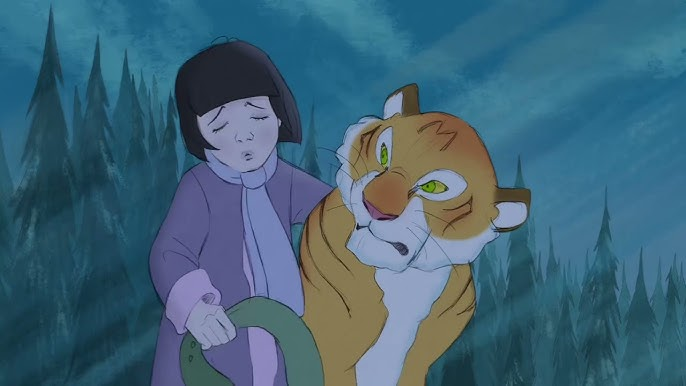
Mushka is a beautiful film. In the same way Secret of NIMH reminds me of Classic Disney at its prime, so too did Mushka remind me of Don Bluth at his prime.
An Interesting aspect about Mushka was its setting. It takes place in the Soviet Union during the late 20th century; and it definitely shows. There’s this persistent sense of instability: economic hardship, moral compromise, and quiet desperation that really reflects life during the last years of the USSR. Even the Soviet Social ill of Alcoholism is explored. In one particularly telling moment, Sarah’s father is manipulated into losing Mushka in a card game after being deliberately intoxicated.

With that in view, the film never becomes overtly political. Instead, it stays grounded in Sarah’s perspective. She’s a genuinely kind, innocent character (Like a Soviet version of Anne Marie) trying to hold onto something pure in a world that keeps taking things away from her. The story remains intimate, focused on her relationship with Mushka rather than making grand ideological statements.

One of the film’s most surprising strengths is its length.
Mushka is only 30 minutes long, but feels as emotionally complete as many feature-length films. Nothing is wasted. Every scene serves a purpose. In a way, it feels like a “compressed” version of Don Bluth film, shorter in lengths but just as emotionally complete (and, in some ways, avoiding the more excessive moments)

And that might point to something bigger.
I think anyone who wants to contribute to a 2D animation Renaissance shouldn't look to massive studios trying to recreate the past with blockbuster budgets (It didn't work for Princess and the frog). They should look to projects like this—smaller in scale, more personal, and more willing to take risks. Shorter formats, in particular, could be key. They lower the barrier to entry while still allowing for meaningful, high-quality storytelling. Mushka proves that you don’t need 90 minutes to leave a lasting impact.
In an industry currently saturated with what often feels like interchangeable CGI spectacle, films like Mushka and Snowbear (which I also saw and enjoyed a lot) stand out precisely because they feel intentional, Crafted, and Personal.

To me, Mushka represents the potential for a deeper paradigm shift in animation; away from superficial big budget CGI products of major studios and toward smaller and more meaningful ones by independent creators, especially traditionally animated ones.
I want to leave you with one last piece of fan art I was inspired to do after seeing Snowbear and Mushka. Anyways here's Snowbear (from Snowbear) and Sarah (from Mushka) enjoying soda pop together; Sarah has a can of Popsi (stand in for Pepsi; which was popular in the Soviet Union/Russia) and Snowbear had a bottle of Colca Cola (stand in for Coca-Cola…. Because polar bears.


